
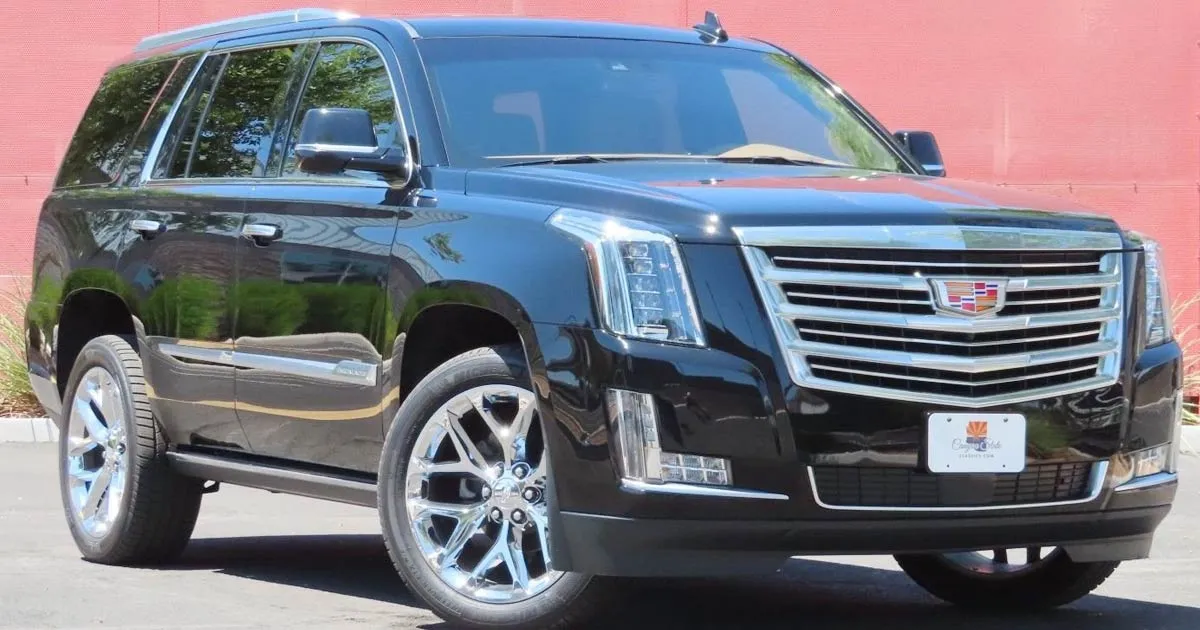
Among Cadillac’s 11 major recalls are those related to critical safety flaws that have affected some millions of Cadillac cars and units made by other GM divisions. Above all, such defects included faulty airbags, faulty brakes, or faulty ignition switches, and other failures. Cadillac vehicle owners and second-hand car buyers should check the VIN through NHTSA or GM to identify potential problems with their vehicle and arrange necessary repairs.
Cadillac uses engines, transmissions, electronics, and truck components shared with other GM models. As a result, some Cadillac vehicles are included in large GM recalls. Some recalls only involve Cadillac cars.
The following 11 recalls vary in severity and scope. The overall number of vehicles affected in each campaign has been provided; however, if the number refers only to a particular vehicle’s recall, the figure will be given along with the name of the model.

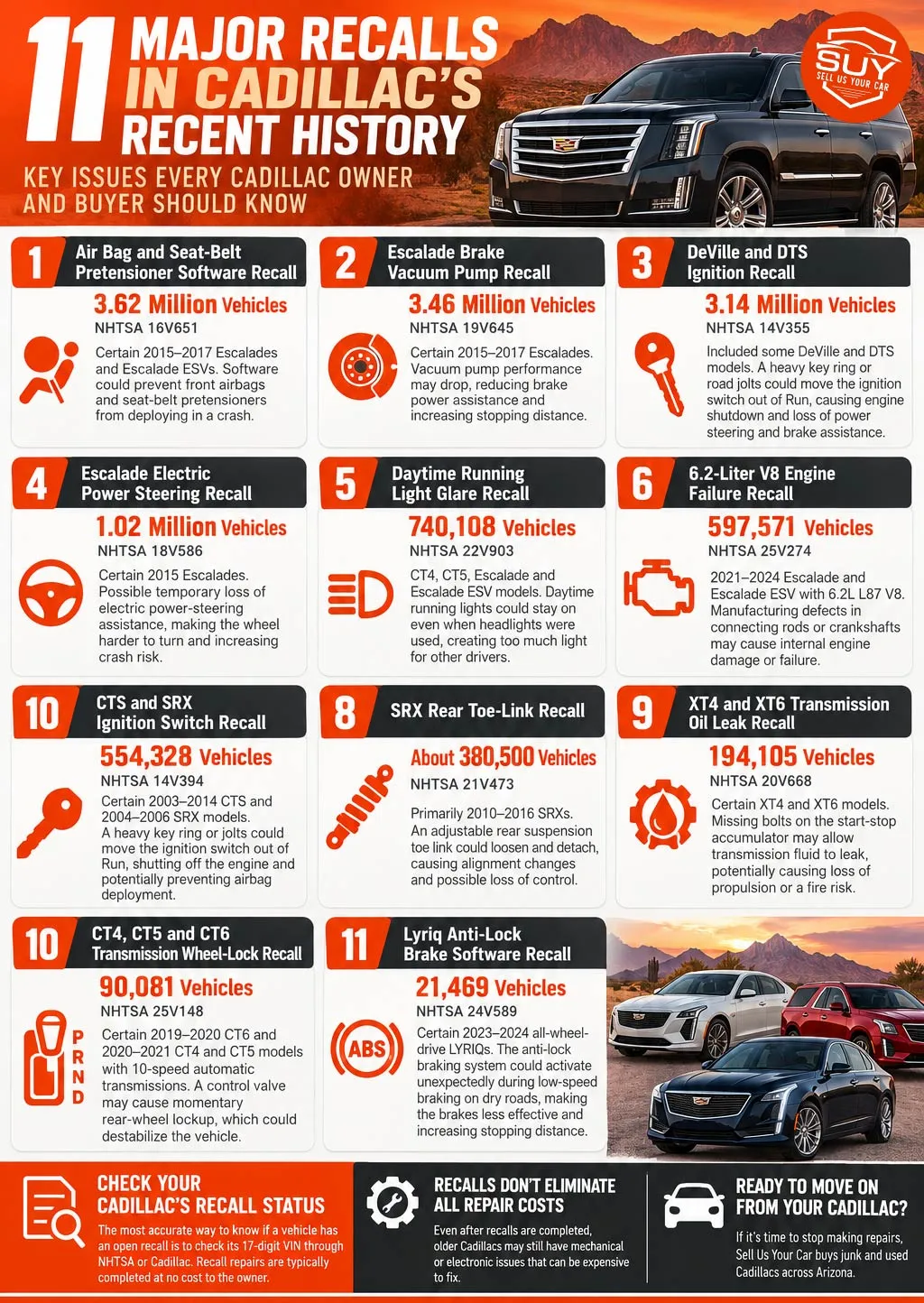
1. Air Bag and Seat-Belt Pretensioner Software Recall – 3.62 Million Vehicles
GM recalled approximately 3.62 million vehicles, including certain 2015-2017 Cadillac Escalades and Escalade ESVs, because of sensing and diagnostic module software.
The software could prevent frontal airbags and seat-belt pretensioners from deploying during a crash. The event is hence classified as one of the largest recalls by GM in the recent past.
2. Escalade Brake Vacuum Pump Recall – 3.46 Million Vehicles
Certain 2015-2017 Cadillac Escalades shared the brake vacuum defect found in Chevrolet and GMC full-size trucks and SUVs. A total of 3,456,719 vehicles were involved in this campaign.
Over time, the vacuum pump performance may drop, reducing brake power assistance. Brakes would still work but require more pressure on the brake pedal and increase stopping distance. Solutions provided by GM included reprogramming the electronic brake control module to boost the brakes’ performance when vacuum is low.
3. DeVille and DTS Ignition Recall – 3.14 Million GM Vehicles
GM’s campaign for its 3.14 million vehicles included some Cadillac DeVille and DTS models.
A heavy key ring or road jolts could move the ignition switch out of the Run position. Consequently, the engine would lose power, and power steering and brake assistance would stop working properly. The airbag system could be affected as well.
4. Escalade Electric Power Steering Recall – 1.02 Million Vehicles
GM recalled 1,015,918 trucks and SUVs, including certain 2015 Cadillac Escalades, for a possible temporary loss of electric power-steering assistance.
Although the steering remained mechanically connected, the sudden loss of assistance could make the wheel harder to turn. Sudden changes in steering effort may prompt drivers to overcorrect, increasing crash risk.
5. Daytime Running Light Glare Recall – 740,108 Vehicles
The recall of 740,108 General Motors vehicles included Cadillac CT4, CT5, Escalade, and Escalade ESV models due to the issue with daytime running lights still functioning even when regular headlights were used.
Federal safety standards require daytime running lights to deactivate when the headlights are on, as too much light in front of the vehicle can disturb other drivers. GM addressed the problem through software updates, including over-the-air updates on certain vehicles.
6. 6.2-Liter V8 Engine Failure Recall – 597,571 Vehicles
The 2021-2024 Escalade and Escalade ESV with GM’s 6.2-liter L87 V8 were included in a major engine recall.
Manufacturing defects in connecting rods or crankshafts may cause internal engine damage or failure. The entire GM recall includes 597,571 trucks and SUVs. Cadillac had approximately 126,000 Escalade and Escalade ESV cars in the recall.
Engine failure can cause a loss of propulsion while driving.
In January 2026, NHTSA opened Recall Query RQ26001 over reports of failures after repairs. On August 20, it advanced the inquiry to Engineering Analysis EA26005.
7. CTS and SRX Ignition Switch Recall – 554,328 Vehicles
GM recalled 554,328 Cadillacs, including certain 2003-2014 CTS and 2004-2006 SRX models, over ignition switches.
A heavy key ring or jolts on bumpy roads could move the ignition switch out of “Run” and shut off the engine. Without movement of ignition to the right position there was a possibility that during a collision the airbags would not deploy. Owners were advised to remove unnecessary items from key rings until repairs were completed.
8. SRX Rear Toe-Link Recall – About 380,500 Vehicles
GM recalled about 380,500 vehicles, primarily 2010-2016 Cadillac SRXs, because an adjustable rear suspension toe link could loosen and detach.
A separated toe link can shift rear-wheel alignment and cause loss of control. GM changed the adjustable links with redesigned non-adjustable parts. The recall followed an earlier campaign addressing the same problem.
9. XT4 and XT6 Transmission Oil Leak Recall – 194,105 Vehicles
Some models of Cadillac XT4 and XT6 were part of a 194,105-vehicle GM recall due to potential missing bolts on the start-stop accumulator of the transmission.
Missing bolts may allow transmission fluid to leak, potentially causing loss of propulsion. Furthermore, if the fluid touches a sufficiently heated component, then it can also pose some fire danger.
10. CT4, CT5 and CT6 Transmission Wheel-Lock Recall – 90,081 Vehicles
In 2025, GM recalled certain 2019-2020 CT6 and 2020-2021 CT4 and CT5 models equipped with 10-speed automatic transmissions.
Wear in a transmission control valve can cause momentary rear-wheel lockup while driving. Such locking could destabilize the vehicle almost instantly. GM is fixing the issue by using transmission-control software that detects signs of the problem before wheel locking occurs.
11. Lyriq Anti-Lock Brake Software Recall – 21,469 Vehicles
As Cadillac expanded into electric vehicles, it encountered a software-related brake issue. Certain 2023-2024 all-wheel-drive LYRIQs were recalled because their anti-lock braking systems could activate unexpectedly during low-speed braking on dry roads.
The incorrect activation of ABS may release braking pressure, making the brakes less effective or potentially inoperative. This means longer stopping distance that may lead to accidents. GM’s remedy is an electronic brake control module software update.
What Cadillac’s Recent Recalls Show
Cadillac recalls have involved engines, transmissions, steering, brakes, suspension, ignition systems, airbags, and software. As a result, when you’re looking at a previously owned luxury car, you have to keep in mind that a Cadillac might appear to be in exceptional condition, but it may still have outstanding recalls associated with its VIN.

The best way to ascertain if a vehicle has an open recall is to check its VIN instead of relying on the recall lists based on model years. Manufacturers generally provide safety recall repairs at no cost to the owner, and the NHTSA site will show whether a vehicle has any unrepaired recalls within the scope of its lookup.
Completing a recall does not necessarily make an older Cadillac economical to own. Older Escalades and SRX crossovers as well as CTS sedans may have mechanical problems or electronic repair needs that are unrelated to recalls. Arizona residents who decide it is time to stop making repairs can turn to Sell Us Your Car, which buys both junk Cadillacs and used Cadillacs across Arizona.


